

From KPI to Value Question: Talk2Earth @ StadtWerte

Urban development needs data. But data alone does not make a good city.
Stadtwerte starts with this question: What is a city worth when real estate prices, land-use metrics, returns, or classical KPIs are not enough? How can common good, climate resilience, social participation, resources, atmosphere, and future viability become visible and discussable?
So the question is not only: What data do we have?
It is also: What meaning do we give to that data?
A KPI is never the value itself. It is always a proxy: an approximation of something we actually want to understand. A vegetation index is not automatically quality of life. Surface temperature is not automatically vulnerability. A change in built-up area is not automatically progress. Only through interpretation does a number become an argument.
The value does not emerge from the number. It emerges from understanding what the number stands for.
The same principle shapes Datentreiber’s work with clients: strategy is not the PowerPoint deck at the end of a project, but the foundation for a shared understanding. It creates orientation around which goals are being pursued, which assumptions sit behind them, and which data or KPIs actually help people make better decisions. Like a KPI, a strategy is not a fixed representation of reality, but a deliberately chosen frame of reference — collaborative, dynamic, and open enough to learn from new insights.
Here, Talk2Earth builds the bridge to Stadtwerte.
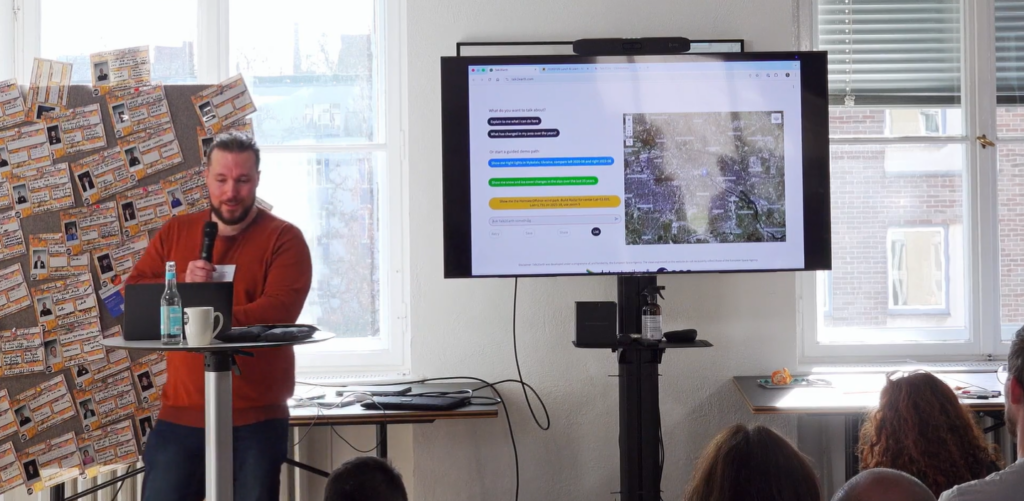
We explored this bridge in our impulse talk at STADTWERTE Basecamp 2026; the recording is available here: https://next.frame.io/share/7be7acde-55af-4aef-a5af-bc7e786ede04/view/7b14fb57-e096-423e-abd4-a3f372b9319f
Earth observation becomes accessible
With Talk2Earth, the first interaction is not a map layer, a filter menu, or a finished dashboard. It is a conversation.
Users do not need to be experts in Earth observation. They do not need AI expertise. They do not even need to start with a fully formulated urban-planning question. An idea, a suspicion, an observation, or a need is enough:
“Where is my city getting hotter?”
“Which neighborhoods are losing green space?”
“Where is the built environment changing most strongly?”
“Which areas may be relevant for climate resilience?”
These are not ready-made analyses. They are value questions. Talk2Earth helps sharpen them through dialogue: What exactly should be investigated? Which data could provide useful signals?
In this way, Talk2Earth democratizes Earth observation expertise. Knowledge that used to be available mainly to specialists becomes accessible through a conversational interface.
From idea to mini-application
In the background, Talk2Earth combines three capabilities that rarely come together in one system: dialogue, code generation, and Earth observation expertise.
The language model has to understand what the user means. It has to translate that intention into a usable question. And it has to connect that question with existing analytical building blocks.
The technical core is not arbitrary code generation. Talk2Earth works with a curated library of Earth observation templates. These templates are created and reviewed by domain experts and described semantically. The system therefore does not only know which code exists; it also understands the meaning, data logic, and typical use case behind it.
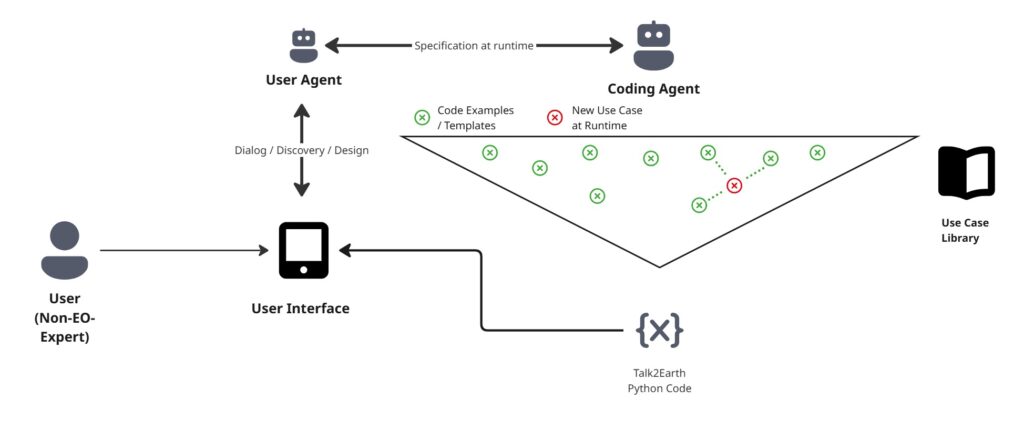
At runtime, the language model can select a matching template, combine several templates, or create a variant. This makes it possible to generate small applications for concrete questions — mini-apps instead of one large, fixed dashboard.
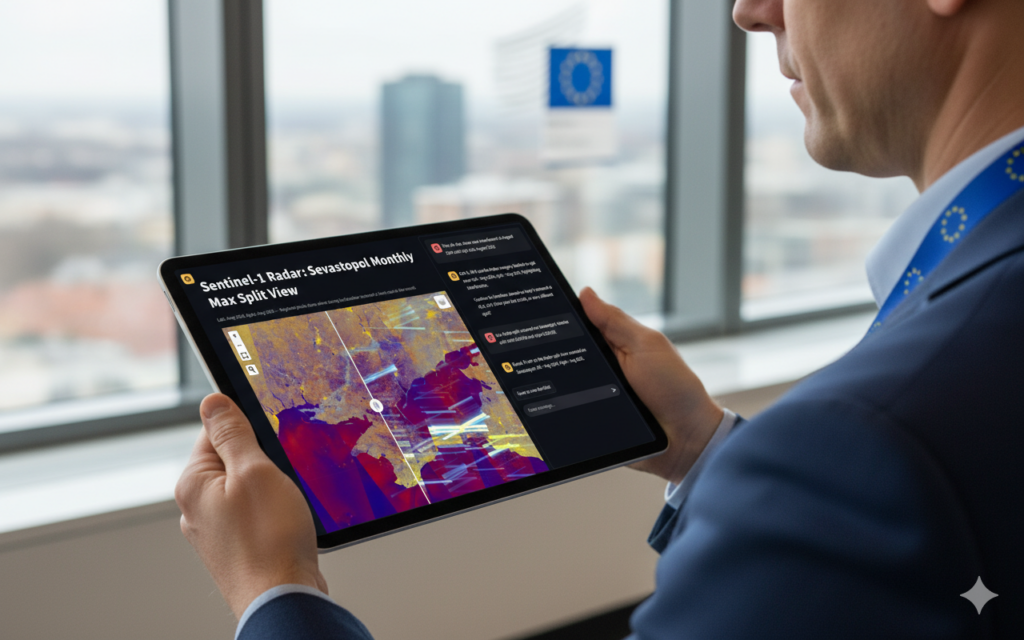
We see: the most relevant output of Talk2Earth is often not the metric itself, but the reasoning around it: which proxy was chosen, which assumption it carries, and where its usefulness ends. That keeps the value question open enough for discussion — and concrete enough to be tested with data.
For Stadtwerte, this is the productive shift: urban value is not reduced to a KPI, but made explorable through dialogue, data, and interpretation.


Responses