

Talk2Earth: Earth Intelligence for Everyone, Everything, Everywhere, Everytime

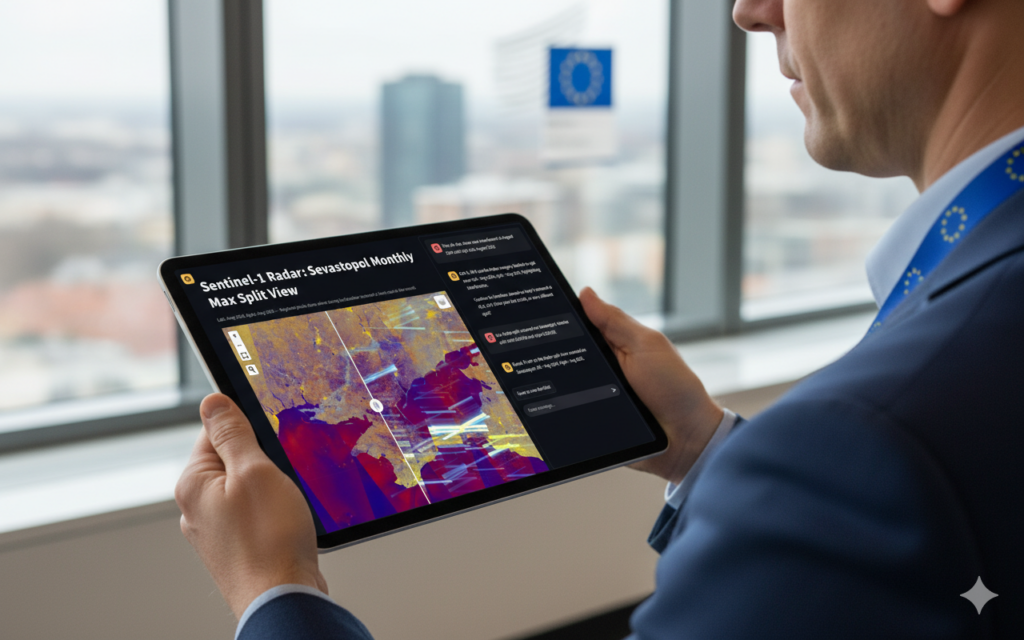
It started with a simple question from our customer, the European Space Agency (ESA): how to make the data (from the Copernicus satellites) available to people who are not experts (in Earth observation)? Many companies face a similar challenge: Make company data usable to every employee.
Chatsbots Replace Dashboards
The typical answer is: a dashboard. But a dashboarding tool requires training. Our answer was: Talk2Earth.com – a free-, easy-, and ready-to-use chatbot that anyone can use to talk about anything (related to Earth), anywhere, anytime.
We were inspired by vibe coding tools: they enable anyone to build apps for anything. Talk2Earth is for vibe analysis: it enables anyone to build Earth observation data analysis and visualization apps (so called “Earthlets”).
This chat-with-data approach provides benefits for all organizations:
🚀 Quick start: No tools and no trainings are required.
🛠️ Full flexibility: users discover, define, develop, and deliver their own use cases.
♾️ Endless possibilities: There are no limits on what for and how the data is utilized.
⚡ Rapid prototyping: New use cases can be experimented with and implemented immediately.
Now, let’s dive into the LLM-based solution Talk2Earth from a user’s perspective to show you the potential of Talk2Data.
Discover the Possibilities
Even if you have no idea what is possible with Earth observation data and AI today (spoiler: a lot!), Talk2Earth can help you: just ask in the chat or click one of the buttons (see 1️⃣ in the image below). You can tell Talk2Earth your (professional or personnel) challenge or goal and it will suggest solutions.

Alternatively, you can use the List button to display a list of all available Earthlets and try them out. There are Earthlets for analyzing and visualizing:
- Air quality in your home town.
- Reforestation by PLANT-MY-TREE.
- Urban change of cities.
- Changes in your neighborhood.
- Cool/Heat spots in you area.
- … and many many more!
There is even an Earthlet to track down Santa Claus. We’ll explain how you can create your own Earthlet in a moment.
Define the Result
Next, tell Talk2Earth what you want to see. We have also prepared some demo cases as click stories (predefined prompts so you don’t have to type) for the ESA Ministerial Council Meeting 2025 in Bremen: try one of the colored buttons (see 2️⃣ in the next image). The three colors blue, green, and yellow stand for technological, ecological, and economic use cases.

Develop the Solution
For example, if you press the yellow button, you will see radar images of the Hornsea wind farm in the North Sea. The map shows a so-called split view. You can use the slider to change the view: on the left-hand side, you will see normal images—the wind turbines are not visible there because the resolution is too low. On the right-hand side, Talk2Earth shows radar images. The wind turbines are visible there (see 3️⃣ in the image below): each dot is a wind turbine.

We want to monitor progress on the construction of the wind farm. That’s why we’re prompting Talk2Earth to change its view (or just click the yellow button: see 4️⃣):
When was it constructed? Lets try changing the left split to show 2017-05 and the right split to show 2025-10You can see the result in the next picture below (see 5️⃣) .
Deliver to the World
Once you are satisfied, share your Earth Intelligence solution with others as an Earthlet. Click on Share (see 6️⃣). Before doing so, you must choose a name and description for your Earthlet, for which Talk2Earth already provides a suggestion.

You can share the URL to your Earthlet with anyone. Thanks to open EO data and AI, designing, developing, and distributing Earth Intelligence applications is now that quick and easy.
Development Deep Dive
Curious to learn more? At the virtual Lunch & Learn on January 29, we will provide insight into the development of the Talk2Earth solution. Register for free participation on Luma:
If you are interested in the Agentic AI architecture of Talk2Earth and want to know which LLM tools, prompting techniques, and context engineering tactics we used, please let us know in the comments. 👇 If there is interest, we will also publish a second article with technical details on implementation, for example, about multi-agent systems, few-shot in-context learning, and the Memento method.
Disclaimer: Talk2Earth was developed under a programme of, and funded by, the European Space Agency. The views expressed on this website do not necessarily reflect those of the European Space Agency.

Responses